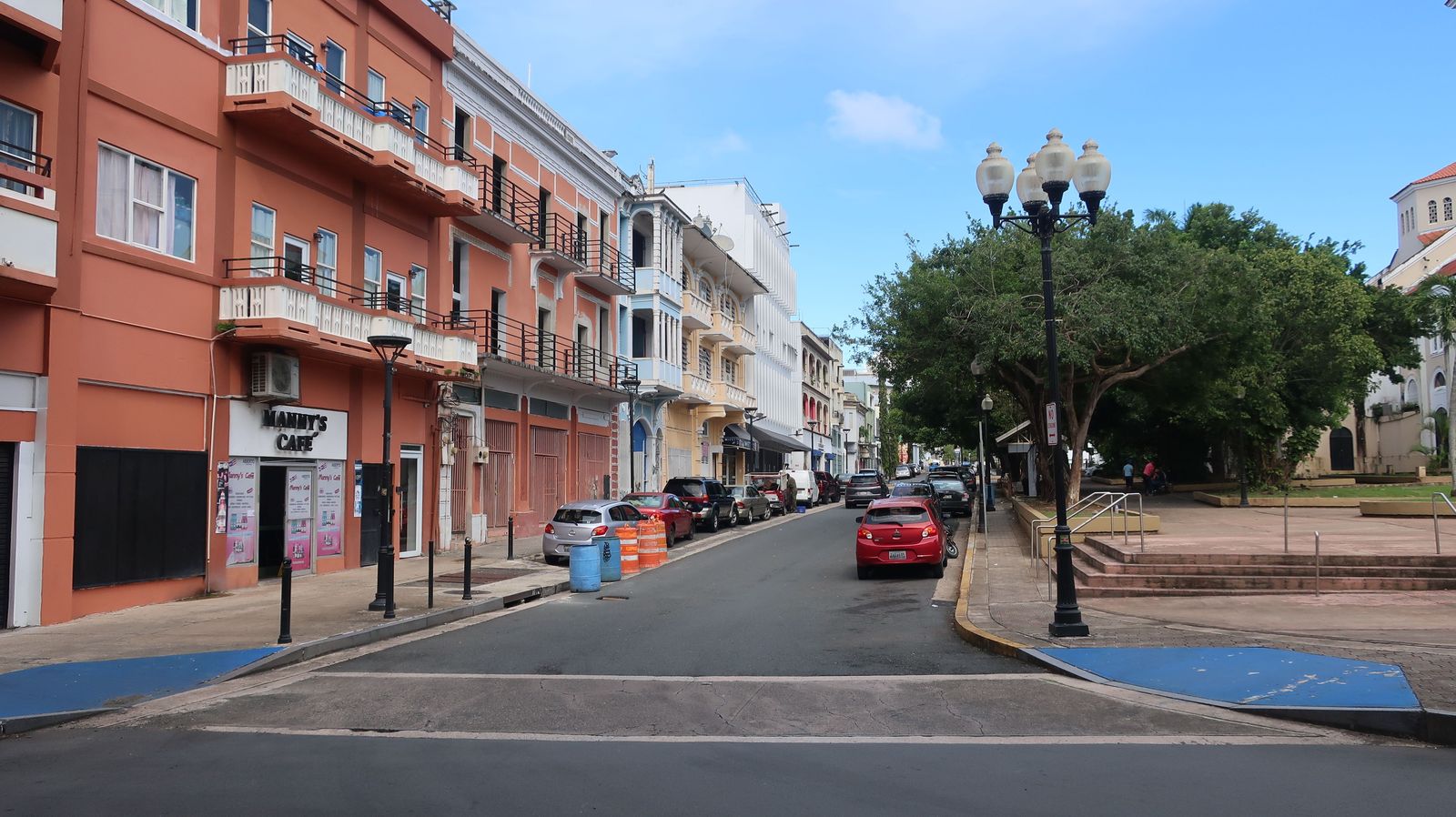
Outside of Old San Juan, you need a car.
GPS always helps. Not all carriers work well on the island, so call yours before you go. Download Waze -- it works best there.
In Old San Juan-- use your feet!
Old San Juan is a very “walkable” town. You may need a whole day to walk around and see the 2 forts. For uphill areas, you can use the free trolley.
A few Differences
Some of the notable differences are that the drivers in Puerto Rico (usually) don’t follow red lights or stop at stop lights--for fear of being hijacked.
Taxi Vs. Uber
In Puerto Rico and anywhere else, it’s safe to use Uber. They are cheap and safe, because you know the drivers’ info, and can be tracked by GPS. Cost-wise, using Uber is way cheaper than getting taxis.
Públicos: The System This Page Left Out
Puerto Rico still runs a real public transportation network the guide never mentions: públicos, shared vans (8 to 15 seats, yellow public-service plates) that run fixed inter-town routes and are the island's only true intercity transit. They still operate in 2026. There's no app and no printed schedule — a público leaves when it's full, not at a set time. Find one at a terminal de carros públicos (Río Piedras has San Juan's main hub, a short walk from the Tren Urbano's Río Piedras station), tell the driver your destination, and pay cash — most don't take cards. Fares run roughly $3–$5 per town-to-town leg.
Renting a Car
At SJU, the major agencies (Alamo, Enterprise, and others) hand off from the terminal to the Car Rental Center directly across from baggage claim — no shuttle needed; a handful of smaller off-airport agencies do run a shuttle. Insurance requirements vary by company: some require you to show proof your own auto policy extends to Puerto Rico, others sell CDW at the counter. Confirm which applies before you're standing at the desk — don't assume any card in your wallet has you covered.
Uber and Taxis
Uber picks up at SJU around the clock from marked curbside zones, and it's solid throughout the San Juan metro — San Juan proper, Condado, Isla Verde, Santurce, Carolina, and into Bayamón and Guaynabo. Outside that ring, coverage thins fast: expect sparse-to-nonexistent Uber in Rincón, Ponce, Aguadilla, the mountains, and the outer islands. Metered taxis still exist in San Juan as a fallback.
The Tren Urbano
San Juan's light rail is real, running, and free right now — fare collection has been suspended since March 2024 with no confirmed restart — but it was built for commuters, not visitors. It skips Old San Juan, Condado, and Isla Verde entirely. Its useful stretch for a tourist is Bayamón to Río Piedras to the Hato Rey business district, with a University of Puerto Rico stop and a connection to the botanical garden.
Driving Quirks Worth Knowing
Gas is sold by the liter island-wide, not the gallon — a pump reading that looks cheap per unit isn't. Waze remains the strongest option for real-time hazards and rural roads Google Maps sometimes gets wrong, though Google Maps has closed the gap for general navigation and points of interest. Mountain roads (the Ruta Panorámica and similar routes) are narrow, switchbacked, and slower than the map suggests — budget real extra time, not just extra miles.
Sources: autoexpreso.com, tollguru.com, alamo.com and enterprise.com SJU pages, globalpetrolprices.com, en.wikipedia.org (Tren Urbano, Terminal de Transportación Pública Carlos Garay), vieques.com — fact-check desk live checks, Sept 2026.